HFM review: does account choice and regulation beat Exness and XM in emerging markets?
HFM offers Cent, Premium, Pro and Zero accounts, a $0 entry and licences from the FCA to the Seychelles. We weighed the choice and the protection against the wide standard spreads and the offshore entity trade-off.
6.9/10
HFM is a broad, long-running broker whose strength is choice: five account types, MT4 and MT5, copy trading, no deposit or withdrawal fees and a real spread of regulators. Its weakness is cost and clarity. Standard spreads average about 1.4 pips on EUR/USD, inactivity fees apply, and protection depends on which entity takes you. Good for traders who want variety, poor value for scalpers.
Best for
Traders in emerging markets who want choice of account type and platform
Premium account opens with no minimum deposit and no commission
Zero Spread account starts at 0.0 pips, with commission of $3 per side
No deposit or withdrawal fees charged by the broker
Licences from the FCA, CySEC, FSCA, DFSA, CMA and Seychelles FSA
MT4, MT5, a web terminal, its own app and a copy trading service
What does not
Standard-account EUR/USD spread averages about 1.4 pips, above many rivals
Inactivity fee of $5 to $30 a month that escalates after six months idle
Most emerging-market clients sit under lighter offshore entities, not the FCA
No TradingView connection, and the site shows constant promotions
Third-party score of 58.5 out of 100 shows trading costs as the weakest area
Specs
Premium account
$0 minimum, no commission
Pro account
$100 minimum
Zero Spread account
From 0.0 pips, $3.00 per side
EUR/USD standard spread
About 1.4 pips (third-party average)
Platforms
MT4, MT5, WebTrader, HFM App
Deposit and withdrawal fees
None from the broker
Inactivity fee
$5 to $30 a month after a dormant period
FCA leverage
30:1 on major forex pairs
Forex pairs
38
Client protection
Negative balance protection, segregated funds
Insurance
Civil liability cover (limits vary by entity)
If you live outside Europe, the broker you are offered is rarely the broker with the best regulator. That is the uncomfortable starting point for HFM, a firm that holds an FCA licence and a CySEC licence, and also serves large parts of Africa, Asia and the Middle East through other entities. The question is what choice and protection you actually get.
Five accounts, and only two that matter
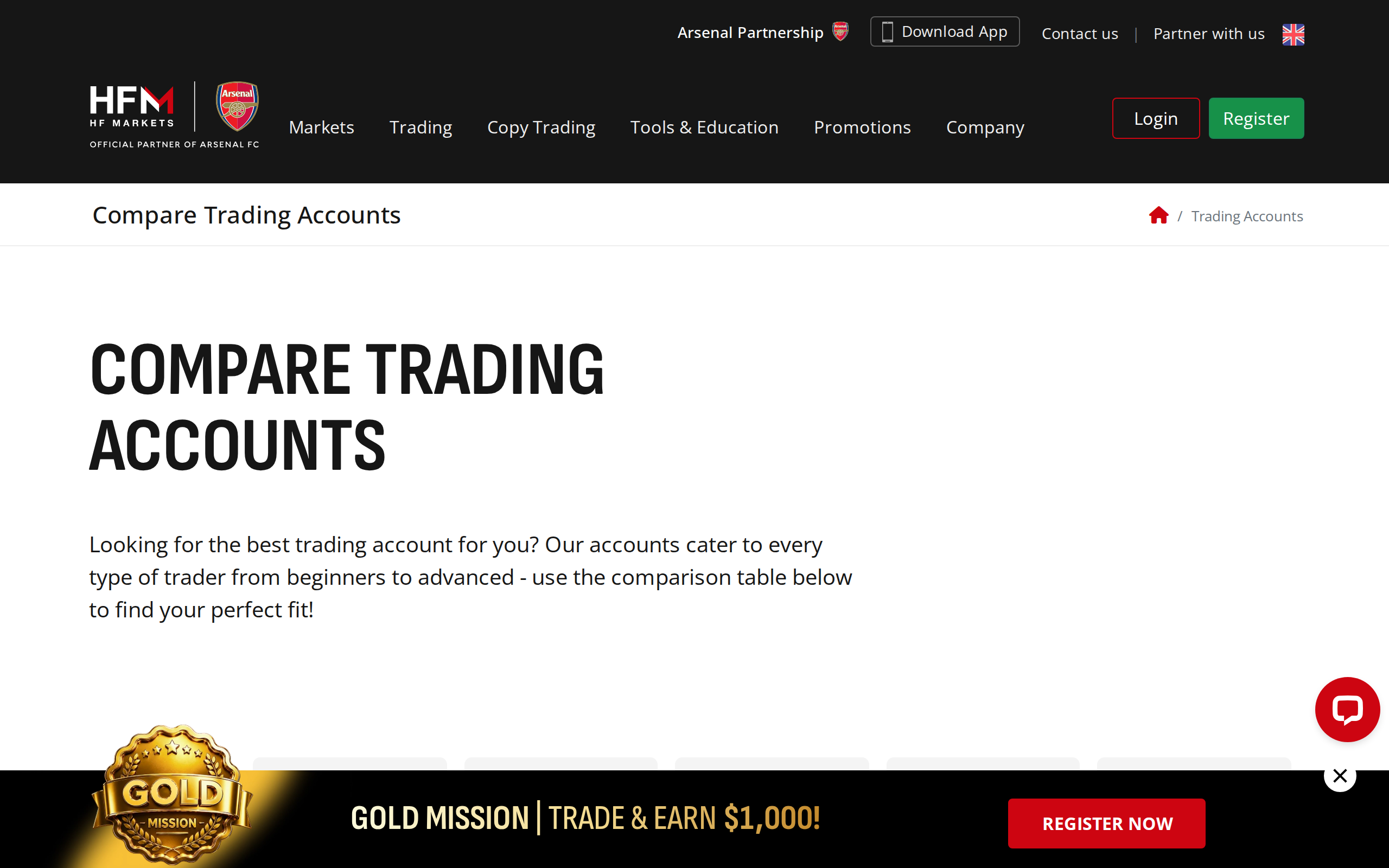
HFM's comparison page is aimed at "every type of trader from beginners to advanced", and the range is wide: Cent, Premium, Pro, Zero Spread and, offshore, a higher-deposit tier. Third-party data (CompareForexBrokers) puts Cent, Premium and Zero at a $0 minimum, Pro at $100 and the top tier at $500.
hfm.com
HFM's account comparison page, with a Gold Mission promotion pinned to the bottom edge.
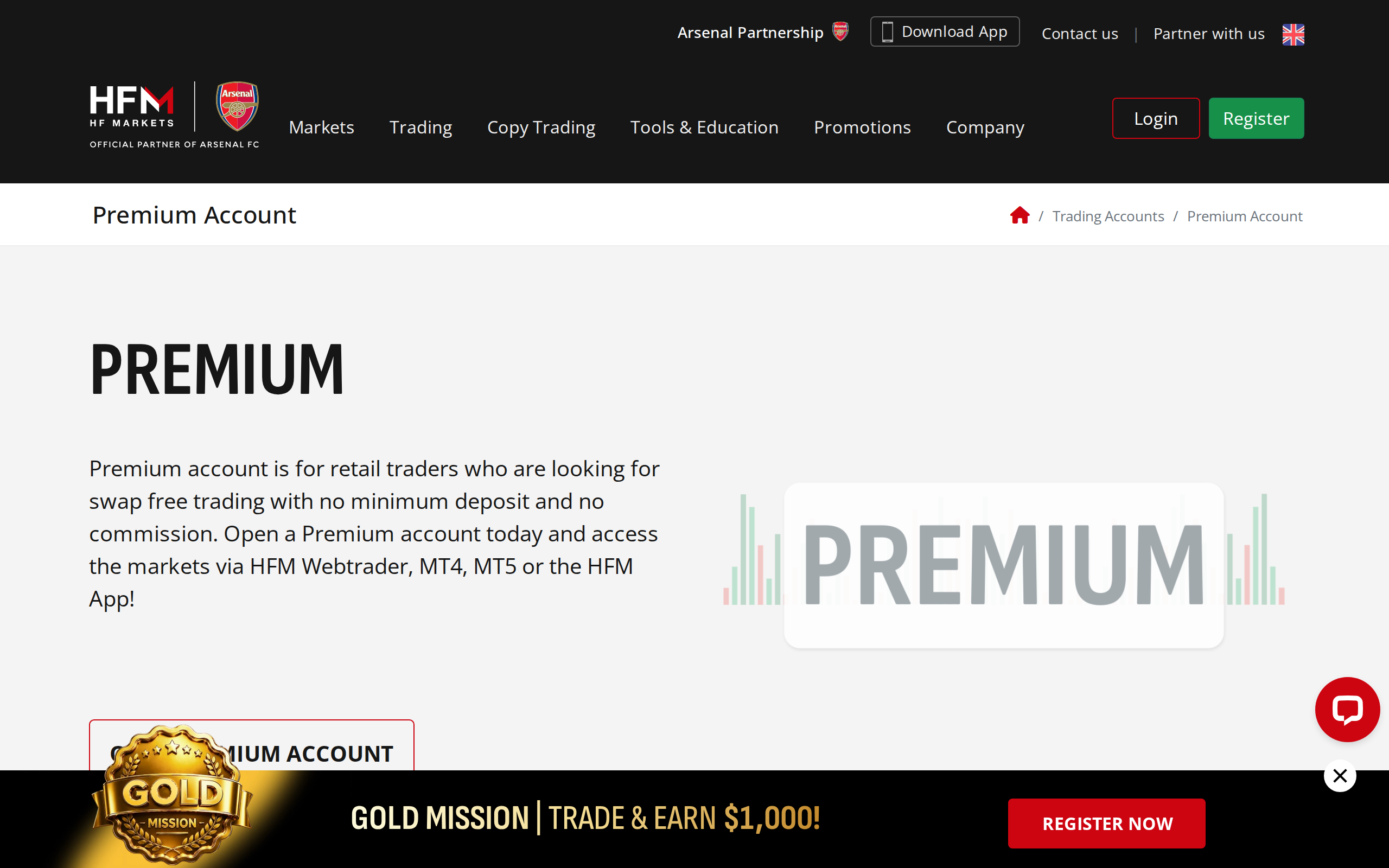
In practice you choose between two models. Premium is swap-free, has no commission and needs no deposit, which suits a newcomer who wants the cost inside the spread. Zero Spread starts at 0.0 pips and charges $3.00 per side, or $6 per round-turn lot, close to the industry average of roughly $3.44 that the same source quotes. The other accounts are variations on those two.
hfm.com
HFM's Premium account page: swap-free, no minimum deposit and no commission.
What trading actually costs
This is where the marketing and the numbers part ways. The front page says "Keep more of every trade", with spreads from 0.0 pips, but the zero-pip figure belongs to the commission account. On a standard account the EUR/USD spread averages about 1.4 pips in independent data, which is wider than the roughly 0.9 pips that XTB's zero-commission accounts average. A Zero Spread account with $6 round-turn commission is the cheaper route for anyone trading often.
Deposits and withdrawals carry no broker fee, which is good for emerging-market traders who move money often. The sting is the inactivity charge: $5 to $30 a month, escalating once an account has been dormant for six months. Leave a small account alone and it shrinks.
The regulation question, answered bluntly
The licence list is long: FCA (801701), CySEC (183/12), FSCA in South Africa, the DFSA in Dubai, the CMA in Kenya and the Seychelles FSA. Only the first two are top-tier. Independent reviewers note that most retail clients are onboarded under the offshore entities, where leverage is higher and investor protection is lighter. The protections listed include negative balance protection, segregated client funds and civil liability insurance, though the limits depend on the entity.
Compare that with Exness and XM. Both also run a mixed set of entities, so none of the three wins on regulation alone. What HFM adds is the FCA and CySEC arms for clients who qualify, and the DFSA in the Gulf.
Where the rivals differ
Exness leans on very high leverage and instant withdrawals in many markets, and XM on a $5 entry and bonus campaigns. HFM's counter is breadth: it is the one of the three that puts a named, tier-one European arm, an African arm and a Gulf arm under one brand. For a trader who moves between countries, or who may one day qualify for a stricter entity, that is worth something. For a trader who will stay in one offshore jurisdiction, it is an argument about a licence they will never use.
The practical test is simple. Before you fund an account, find the legal entity named on your client agreement, check its regulator's public register and read what compensation, if any, applies. That ten-minute check matters more than any spread table.
Copy trading as a second reason to look
HFM runs its own copy trading service, described as a way for any trader to follow Strategy Providers and mirror their positions.
hfm.com
HFM's copy trading page, describing how to follow Strategy Providers.
Copying adds its own risk: past provider results do not repeat on demand, and a provider can change style or blow up. It is a feature, not an edge.
Who should choose HFM
Choose it if you want to start at $0, like the choice of MT4 or MT5 and want a broker that has been around for years. Skip it if you scalp EUR/USD and cost is the whole game, if you want TradingView, or if your entity turns out to be the offshore one and you care about a top-tier safety net.
Verdict
At 6.9, HFM is a dependable middle option: more choice than most and fewer surprises than the cheapest offshore names, but priced like a generalist. A cost-focused trader will find better elsewhere, while a variety-seeker will be content.
Leveraged trading can lose money quickly, and most retail clients do lose. This text is general information on published terms, not personal advice.