IG review: is the biggest listed CFD broker worth the premium?
IG has traded since 1974, sits in the FTSE 250 and offers 17,000+ markets, but its 0.6 point EUR/USD spread is only a minimum. We weighed safety and range against real cost.
7.9/10
IG earns its place for traders who put safety, market range and a long regulatory record ahead of the last fraction of a pip. Its 0.6 point EUR/USD figure is a minimum, and real average costs run higher than a Razor-style account for most sessions, which hurts scalpers first. Choose it for breadth and stability, and skip it if price per lot is your only test.
Best for
Traders who want a listed, heavily regulated broker with wide market choice
Listed on the London market since the 1970s with a long regulatory record
17,000+ markets including FX, indices, shares, commodities and crypto CFDs
Free demo account and its own web platform, plus MT4, MT5 and TradingView
No minimum deposit by bank transfer and a volume rebate for busy traders
What does not
The 0.6 point EUR/USD spread is a minimum, and averages run wider
Bank transfers can take days, so card deposits are the quick route in
Crypto CFD menu is narrow next to a real exchange and holds no coins
Around 70% of retail CFD accounts lose money with this provider
Specs
Markets
17,000+ across FX, indices, shares, commodities, crypto CFDs
FX pairs
68 forex pairs
EUR/USD spread
0.6 points minimum, spread-only pricing
Spot gold spread
0.3 points minimum (IG commodities page)
Retail leverage
1:200 on FX and indices, 1:10 on shares and crypto (international entity)
Platforms
IG web platform, mobile app, MT4, MT5, TradingView, ProRealTime
Regulators
FCA, ASIC, BaFin, MAS, FINMA, CFTC/NFA and others, by entity
UK compensation
FSCS up to £85,000 for eligible UK clients
Founded
1974, London
A raw-spread broker will often beat IG on the average price of a EUR/USD lot. So why does IG keep coming up when readers ask us which broker is safest? Because the trade-off is real, and cost is only half of it.
The spread is a floor, not a promise
IG quotes a 0.6 point minimum on EUR/USD with no separate commission, and 0.3 points on gold. The word that matters is minimum. A Razor-style account at about 0.2 pips plus $7 of commission per lot costs roughly 0.9 pips all in at its tightest, so IG's floor looks competitive on paper. The trouble is that a spread-only price is where the broker keeps its margin, and it widens when volatility rises. Independent tests we found publish minimums far more readily than averages, so treat 0.6 as the best case and budget for more.
That is why the honest comparison is at your trading times, not at the headline. A trader who deals at the London open will see something close to the quoted figure. Someone who trades the Asian lull or a data release will pay more, and a raw-spread account will usually pay less.
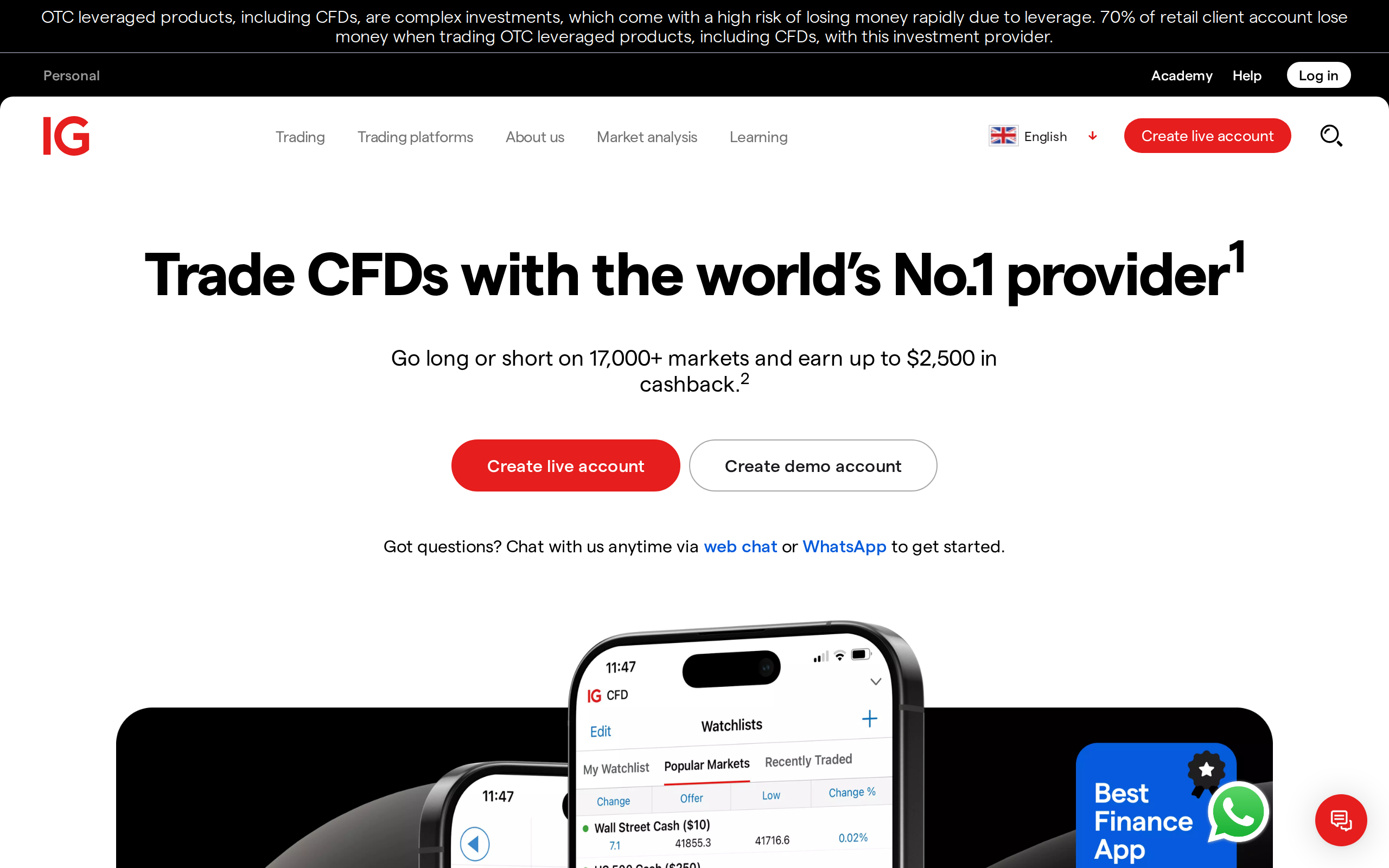
What you get for it is scale. IG lists more than 17,000 markets on its CFD page: 68 forex pairs, over 100 indices, more than 10,000 share CFDs, 47 commodities and a handful of crypto CFDs. A trader who wants to hedge a EUR position with a Bund future, or trade a US earnings gap the next day, will find both in one login.
ig.com
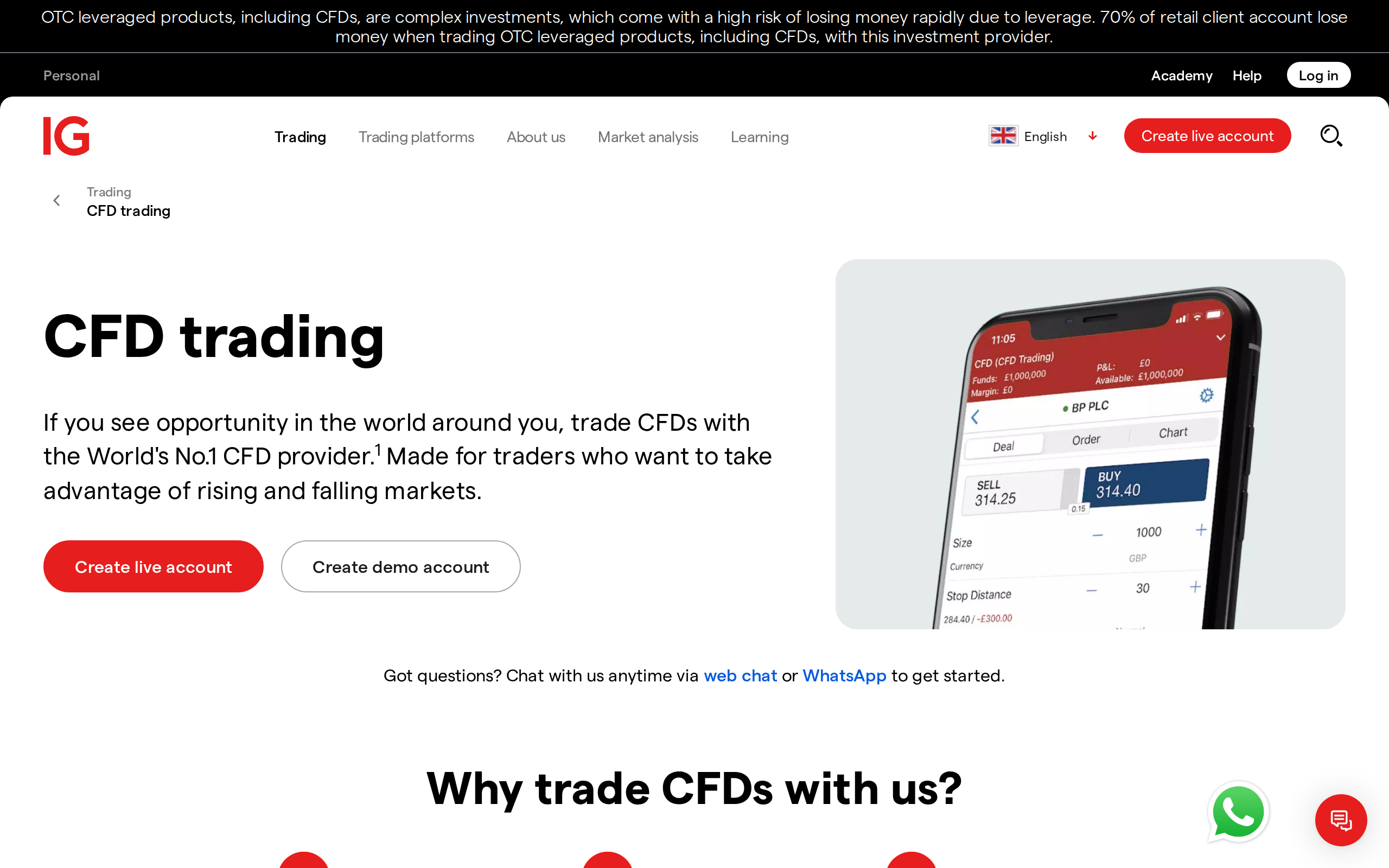
IG's CFD page, which lists the market count, spreads and leverage on one screen.
Leverage for retail clients on this international page is 1:200 on FX and indices, and 1:10 on shares and crypto. Those limits are lower on some IG entities, so the number you see depends on where you live.
The rebate that narrows the gap
There is a lever most reviews skip. IG runs a volume-based rebate programme that returns part of the spread to active traders.
ig.com
The volume-based rebates page: active traders can earn part of their spread back.
The page frames it as rebates on spreads for those who trade often, which is a signal that the base spread leaves room to give some back. We would not build a strategy on it, since qualifying volume is high and the terms change, but it means the sticker spread is not the final word for a heavy user. Read the current thresholds before assuming it applies to you.
Testing without money, funding with it
The free demo is a good place to compare IG's own platform with the alternatives. It gives you the same market list on paper money, and you can switch between the web platform and third-party options such as MetaTrader or TradingView once you hold a live account.
ig.com
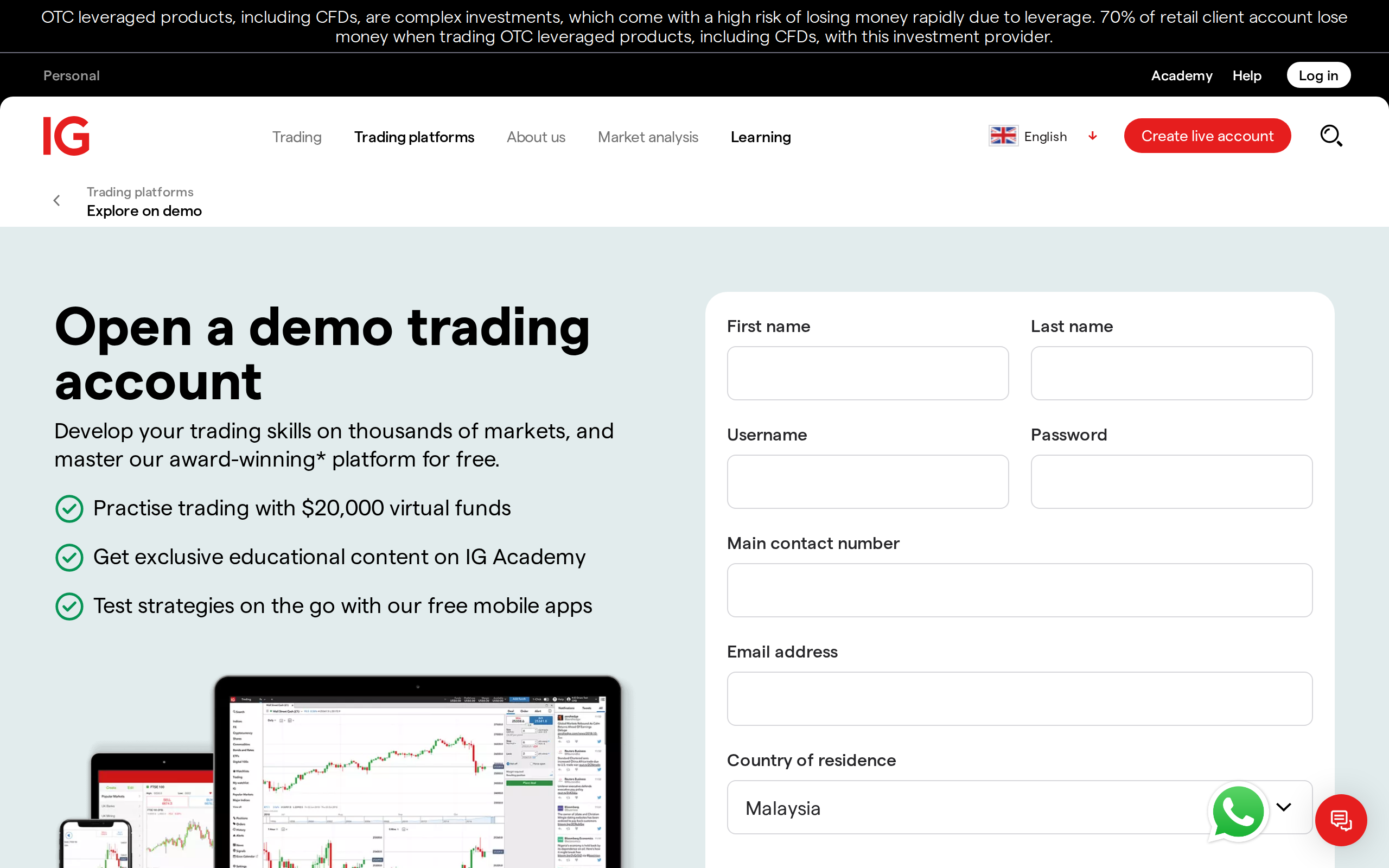
IG's demo account page, where practice trading on the platform is offered without a deposit.
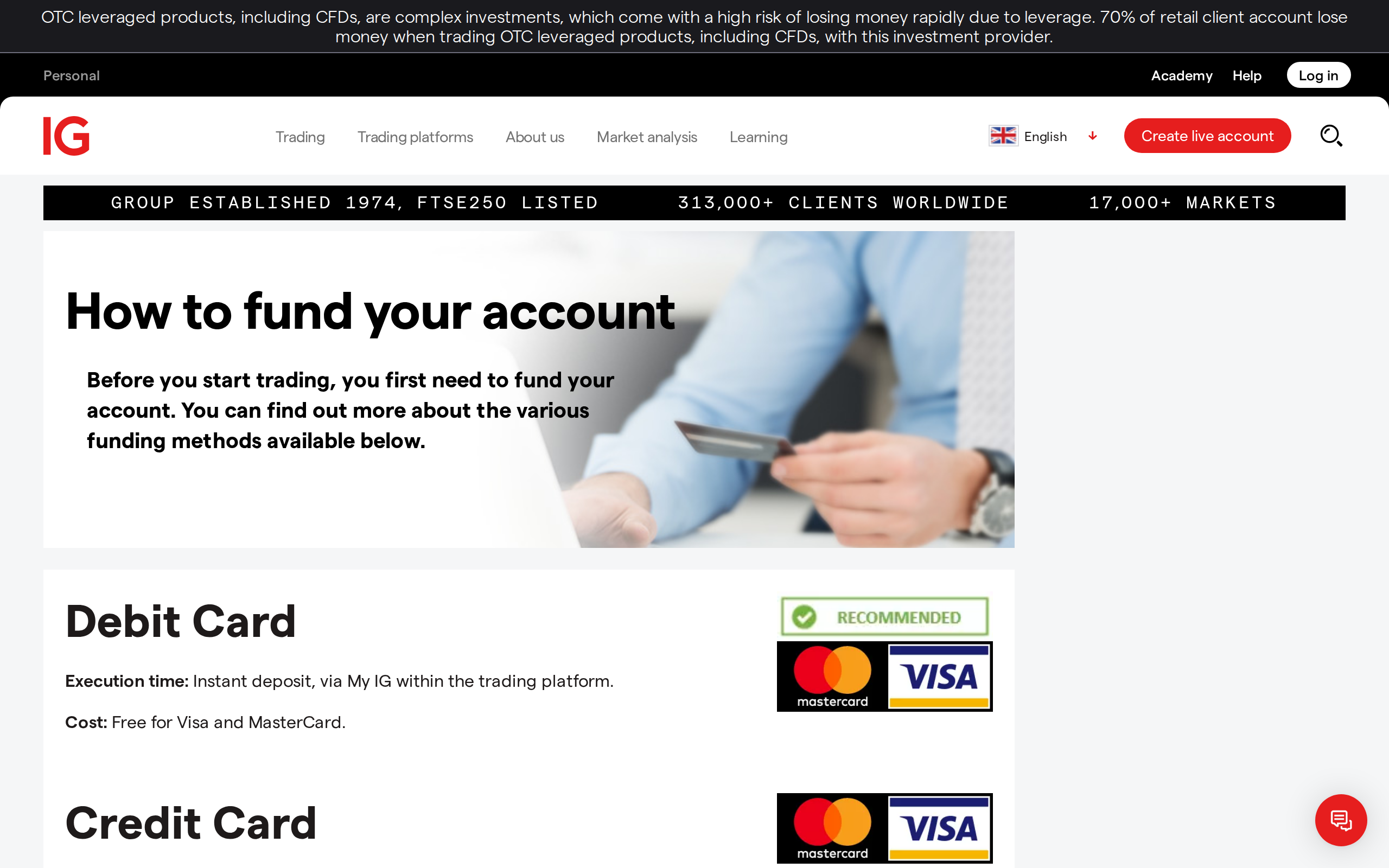
Funding is conventional. IG lists debit and credit cards, bank transfer and other methods on its funding page, and IG advertises no minimum deposit when you fund by bank transfer.
ig.com
The funding page lists card and other methods with the notes on each.
Card deposits are quicker; bank transfers can take days. Withdrawals go back to the source you funded from, which is a standard anti-fraud rule and not a fee.
Safety is the actual product
IG lists licences from the FCA, ASIC, BaFin, MAS and FINMA, among others, and is a long-established listed group. UK retail clients can claim up to £85,000 from the FSCS if the firm fails. That protection is regulated, not marketed, and it is the reason we rate IG higher than its cost alone would justify.
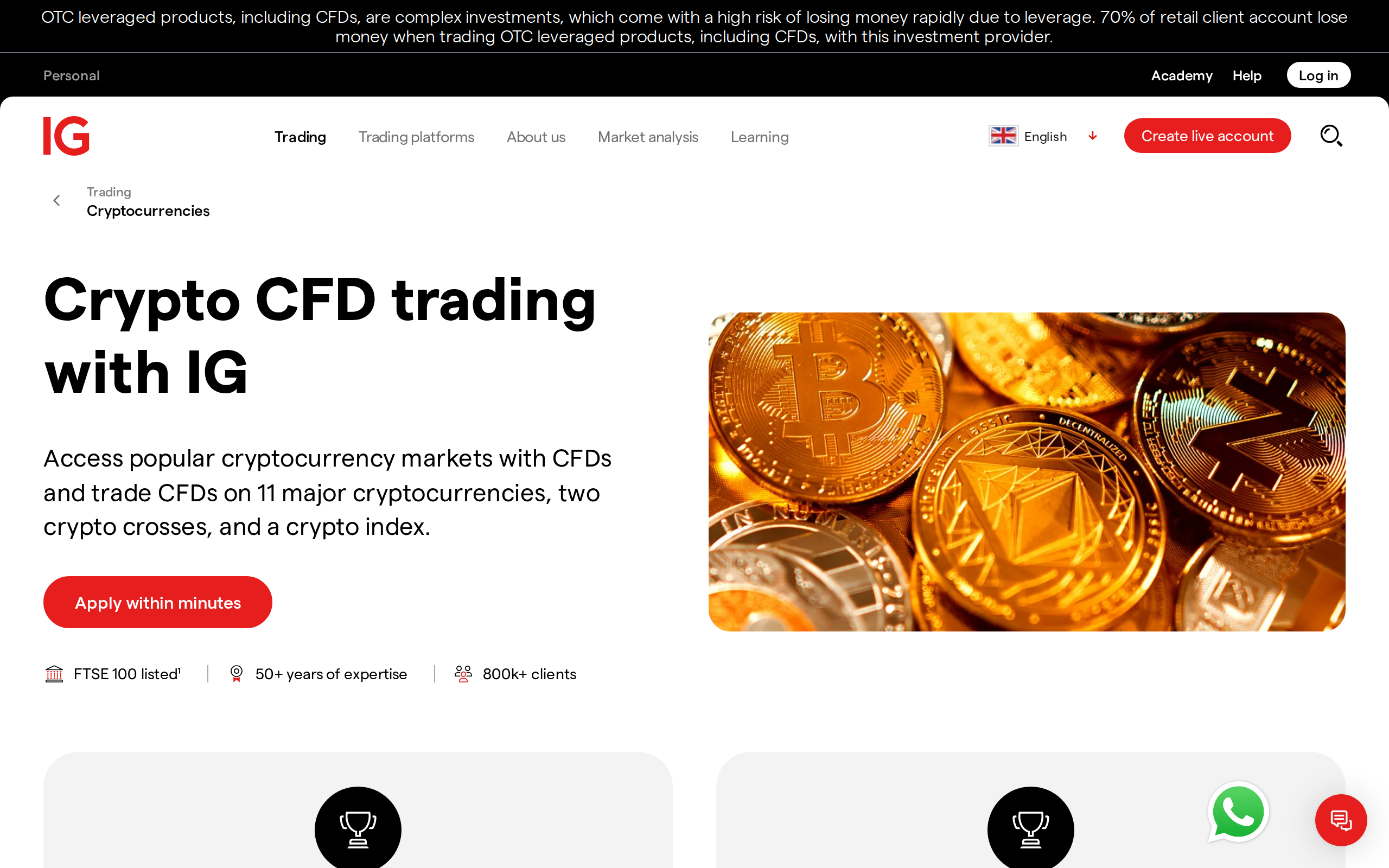
Its crypto offer is where we would push back. IG offers crypto as CFDs on a small set of coins, so you hold no coins and cannot withdraw them to a wallet.
ig.com
IG's crypto page describes CFDs on major coins and crosses, not ownership of the coins.
Where the platform helps and where it nags
IG's own web platform is built for people who trade several asset classes at once: a watchlist, charts, an order ticket with guaranteed-stop options where the entity allows them, and price alerts. It is less configurable than cTrader and lacks the automation ecosystem of MetaTrader, which is why IG also offers MT4 and MT5 for those who want expert advisors.
The complaint we hear most is not the interface but the small fees at the edges: overnight financing on leveraged positions, a currency conversion charge when your account currency differs from the market's, and data fees on some share products. None is unusual, yet all belong in your cost sum before you compare it with a cheaper rival.
Who should choose it
Pick IG if you want one regulated home for FX, indices and shares, and you would rather pay a little more for a firm with a long record. Skip it if you trade EUR/USD all day and count every cent of average spread, or if you want to actually own crypto.
Leverage magnifies losses as fast as gains. IG's own page says about 70% of retail accounts lose money on CFDs. This piece describes a product and is not a recommendation for your circumstances.