Bitstamp review: does the oldest European exchange still make sense under Robinhood?
Bitstamp opened in 2011 and Robinhood bought it in 2025. We read the September 2026 fee schedule, the MiCA licence trail and the complaint record to see who still benefits from an old-school exchange.
7.2/10
Bitstamp is a sound, heavily licensed exchange with a clean fee table and free SEPA and ACH deposits. Its entry tier is dear: 0.30% maker and 0.40% taker below $10,000 of 30-day volume, and 4% for card buys. Support complaints and the lack of a public proof-of-reserves page hold the score down. Fee-conscious active traders should compare Kraken Pro first; euro savers who want a bank-transfer route will find it useful.
Best for
Euro and dollar bank-transfer traders who value licences over the cheapest fees
Free SEPA and ACH deposits, and free ACH withdrawals
Fee tiers fall to 0.00% maker above $100 million of 30-day volume
Regulated across the EU under MiCA and in New York under a BitLicense
Bitstamp Pro gives serious traders a proper order-book screen
Around 159 assets and both spot and perpetual markets
What does not
Entry pricing of 0.30% maker and 0.40% taker is high for small accounts
Instant card and wallet purchases carry a 4% service fee
No public proof-of-reserves page users can check themselves
Frozen accounts, verification friction and slow support draw repeated complaints
Not available in Hawaii and Nevada
Specs
Founded
2011; acquired by Robinhood in June 2025 (about $200 million)
Base trading fee
0.30% maker, 0.40% taker under $10,000 30-day volume
Top-tier fee
0.00% maker, 0.03% taker above $1 billion
Card and wallet purchases
4% Instant Service fee
SEPA
Free deposit, 3 EUR withdrawal
International wire
Deposit 0.05% (7.5 to 300); withdrawal 0.1% (minimum 25)
Assets
About 159 assets, 298 spot and 20 perpetual markets
Derivatives
Perpetuals with leverage up to 10x where eligible
Licences
MiCA (Luxembourg passport), New York BitLicense, UK FCA registration
Bitstamp went live in 2011, back when a Bitcoin exchange was three people and a server rack. It survived the 2015 hot wallet theft (roughly 19,000 BTC, according to CryptoSlate), outlasted most of its rivals, and passed to Robinhood in June 2025 for about $200 million. The question for 2026 is narrow: what does an old exchange with a new owner offer that Kraken or Coinbase Advanced does not?
The fee table is where the story turns
Most exchange reviews open with the licences. We opened with the fee schedule, valid from 1 September 2026, because it shows who Bitstamp is built for.
bitstamp.net
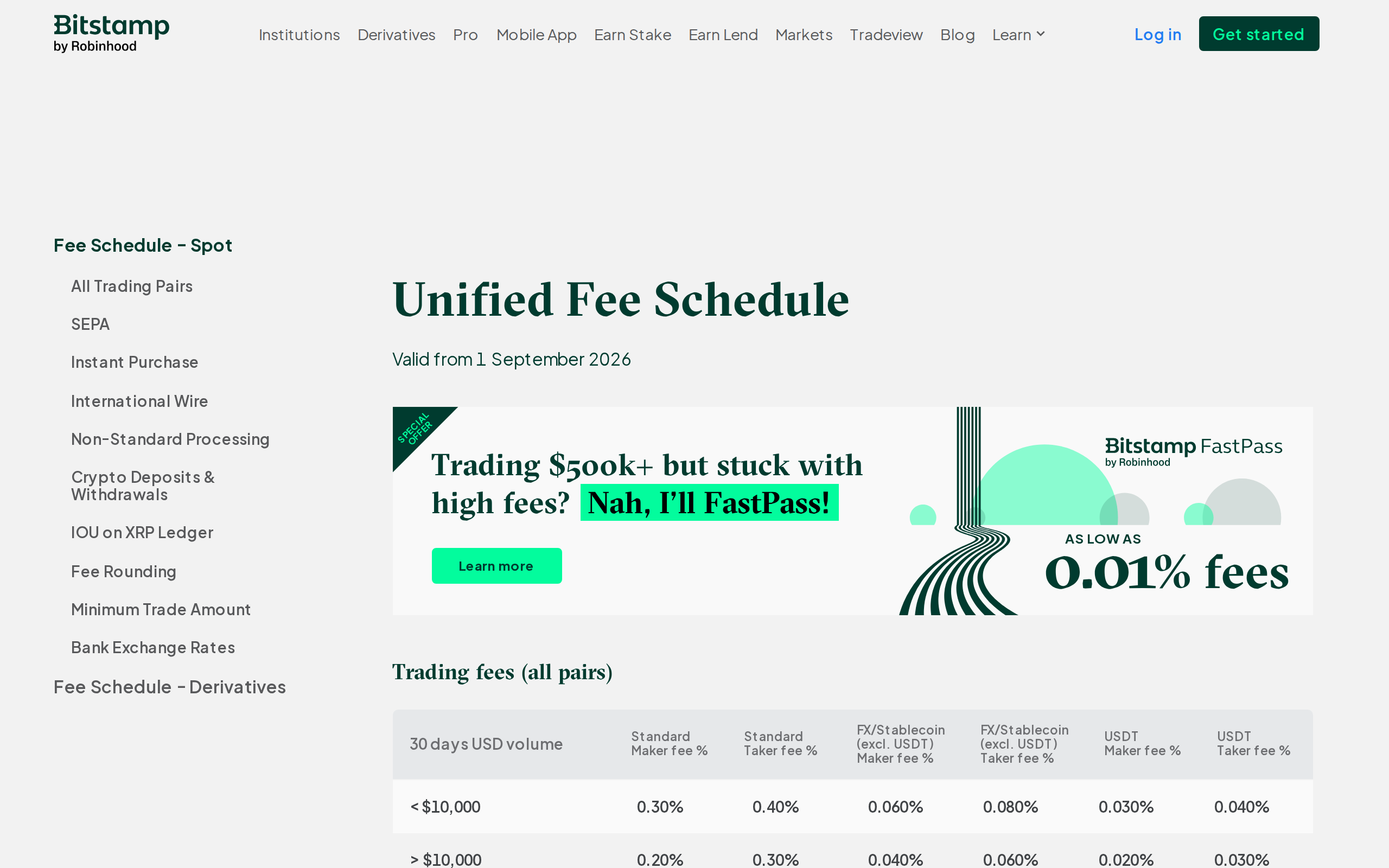
The unified fee schedule, showing trading fees by 30-day volume and a FastPass banner for $500k+ traders.
Under $10,000 of 30-day volume you pay 0.30% as maker and 0.40% as taker. Cross $100,000 and it drops to 0.10% and 0.20%. Reach $1.5 million and it is 0.06% and 0.16%. Only above $100 million does the maker fee reach zero. Stablecoin and FX pairs get their own cheaper column, but their volume counts for only 20% toward your tier (10% for USDT/USD and USDT/EUR).
So a casual trader moving $2,000 a month pays around $8 on the taker side. That is not a scandal. It is simply more than the rivals charge at the same size, and it buys nothing extra.
The instant route is worse. Buying with a card, Apple Pay or Google Pay attracts a 4% Instant Service fee, on top of anything the card issuer adds. Use the order book, or a bank transfer, and the problem disappears.
Getting money in and out
This is the part Bitstamp does well. SEPA deposits are free, and a SEPA withdrawal costs 3 EUR. ACH deposits and withdrawals in the US are free. UK Faster Payments deposits are free with a 2 GBP withdrawal. International wires are dearer: 0.05% to deposit (between 7.5 and 300 in the main currencies) and 0.1% to withdraw, with a 25 minimum.
For a European saver who buys Bitcoin monthly by bank transfer, those rails matter more than a fraction of a percent on trading.
What Robinhood changed, and what it did not
Ownership brought a bigger balance sheet and a push into Europe. Bitstamp holds a MiCA licence through Luxembourg with EU passporting, a New York BitLicense for its US arm, and UK registration with the FCA. In April 2026 it added perpetual futures for eligible EU users, capped at 10x leverage.
bitstamp.net
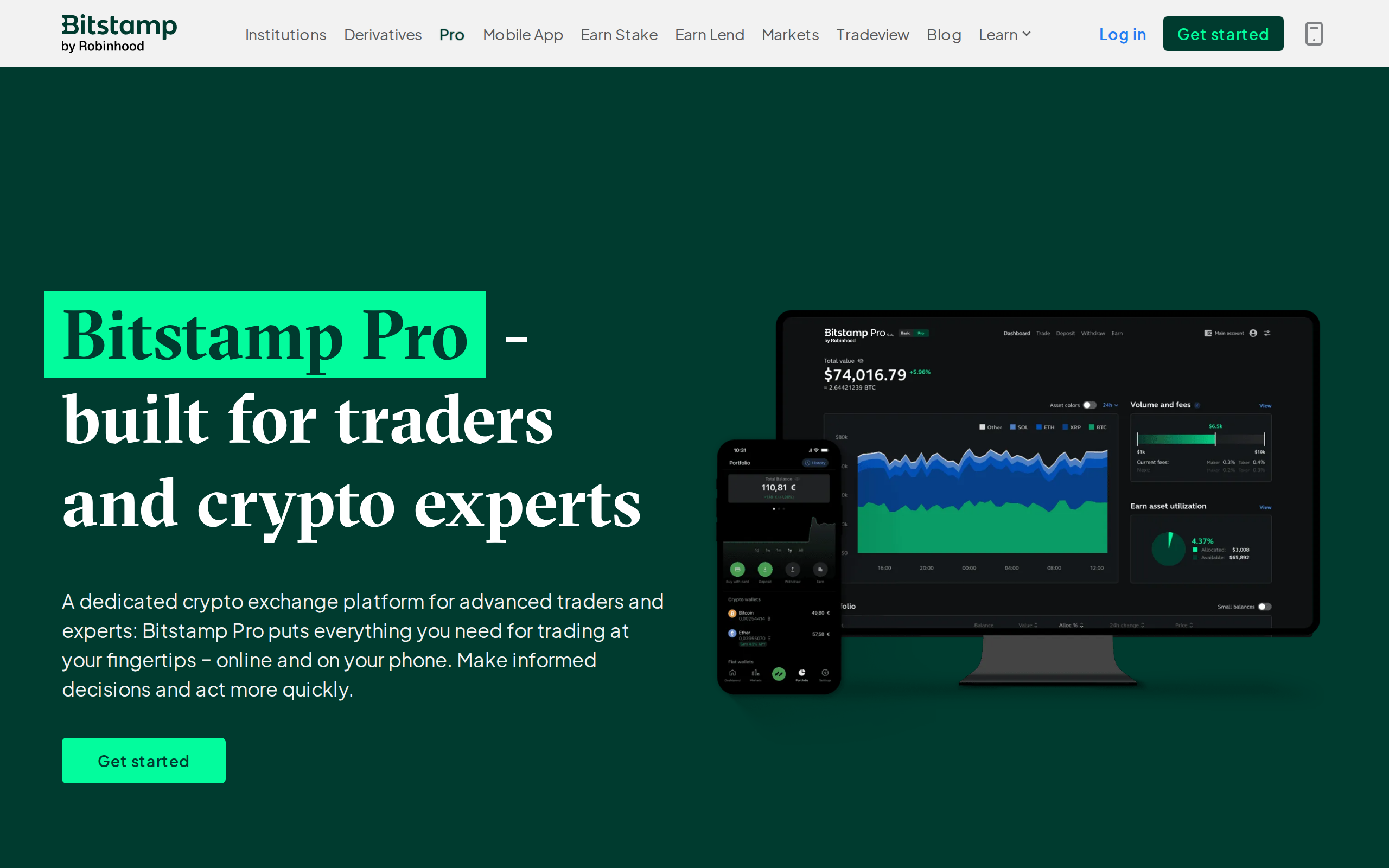
The Bitstamp Pro page, describing the dedicated platform for advanced traders.
Bitstamp Pro is the screen an active trader should use: a full order book, charts and a cleaner path to maker pricing. The simple app is for people who do not mind paying for convenience.
What did not change is the support record. Complaints gathered by CryptoSlate centre on frozen accounts, slow compliance reviews and verification friction, and the same review notes there is no public proof-of-reserves page users can check. In practice, that means you should complete verification on a quiet day, not on the day you need to move funds.
How we would compare it
The honest rival set is Kraken and Coinbase Advanced. Kraken Pro tends to open a little cheaper for small accounts and lists more coins. Coinbase has the larger US user base and an easier app. Bitstamp's argument is the licensing trail: a MiCA authorisation passported across the EU, and a long operating history in which the one major loss, in 2015, was covered by the company.
If you are not chasing the last basis point, the deciding factor may be which bank rails your country supports. Check that your own deposit method is free before you assume the headline rates apply to you. Run a small test deposit and a small withdrawal first; both take minutes and teach you how verification actually feels.
The market list
Around 159 assets trade on 298 spot markets, a curated list rather than a casino of long-tail coins.
bitstamp.net
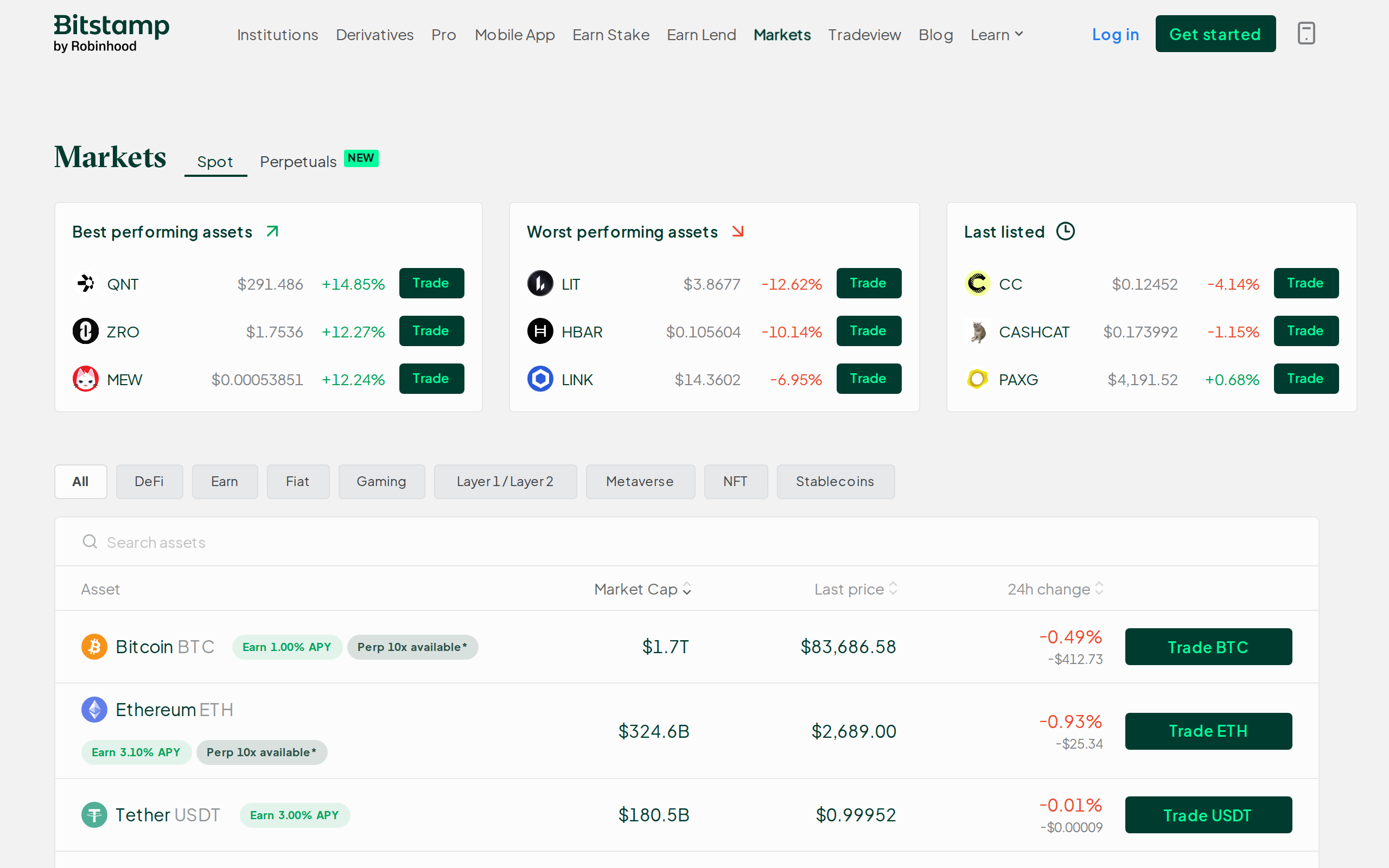
The markets list, showing prices, Earn APY figures and perpetual availability beside each asset.
Some coins show an Earn rate beside them and a perpetual tag (Bitcoin was listed at 1.00% APY and Ether at 3.10% when we looked). Those rates move, and staking or lending returns are never guaranteed.
Who should use it
Choose Bitstamp if you value regulatory cover, fund by bank transfer, and trade often enough to reach the lower tiers. Skip it if you are a small trader chasing the lowest fee, if you want a huge altcoin menu, or if you might need fast human support. US residents in Hawaii and Nevada cannot use it at all.
Crypto is volatile and leveraged products magnify losses, so only stake what you can afford to lose. This piece describes a product; it is not advice on what to buy.