XTB review: does xStation make it the best all-round CFD broker for Europeans?
XTB charges no account fee, no CFD commission and no minimum deposit, and runs one in-house platform, xStation 5. We checked the fee page, the spreads and the regulators to see where it falls short.
8.4/10
XTB is the most coherent broker for a European who wants forex, index and stock CFDs plus real shares and ETFs in one account. Costs are plain, regulation is broad and xStation 5 is easy to learn. The limits are a single platform focus, a 0.5% currency conversion charge and a $30 fee on withdrawals under $50. Skip it if you need cTrader, TradingView charts or raw-spread pricing.
Best for
European traders who want CFDs and real ETFs in one simple account
No minimum deposit, no account opening fee and no maintenance fee for active clients
0% commission on CFDs, with spreads from 0.5 pips on the published specification
xStation 5 covers 12,000+ instruments on web, desktop and mobile
Listed on the Warsaw Stock Exchange and overseen by regulators in nine jurisdictions
Real stocks and ETFs are commission-free up to EUR 100,000 of monthly turnover
What does not
0.5% currency conversion charge hurts traders funding in another currency
Withdrawals under $50 cost a flat $30
No raw-spread account: EUR/USD averages around 0.9 pips with zero commission
Stock and ETF commission rises to 0.2% (minimum EUR 10) above the monthly turnover cap
Custom automation and third-party charting are thin next to MetaTrader or cTrader
Specs
Minimum deposit
None
Account opening and maintenance
Free for active clients
CFD commission
0%
Minimum spread
0.5 pips (published specification)
EUR/USD average spread
About 0.9 pips (third-party averages)
Maximum leverage
1:500 (non-EU entities)
Currency conversion
0.5%
Withdrawals
Free above $50, $30 below
Platform
xStation 5 (web, desktop, iOS, Android)
Instruments
12,000+ stocks, ETFs and CFDs
Listing
Warsaw Stock Exchange (XTB)
Most brokers make you choose between a simple app and a serious one. XTB tries to be both, and the fee page shows how it pays for that: nothing up front, nothing on CFD commissions, and a handful of small charges hidden at the edges. We read those edges closely.
What XTB charges, line by line
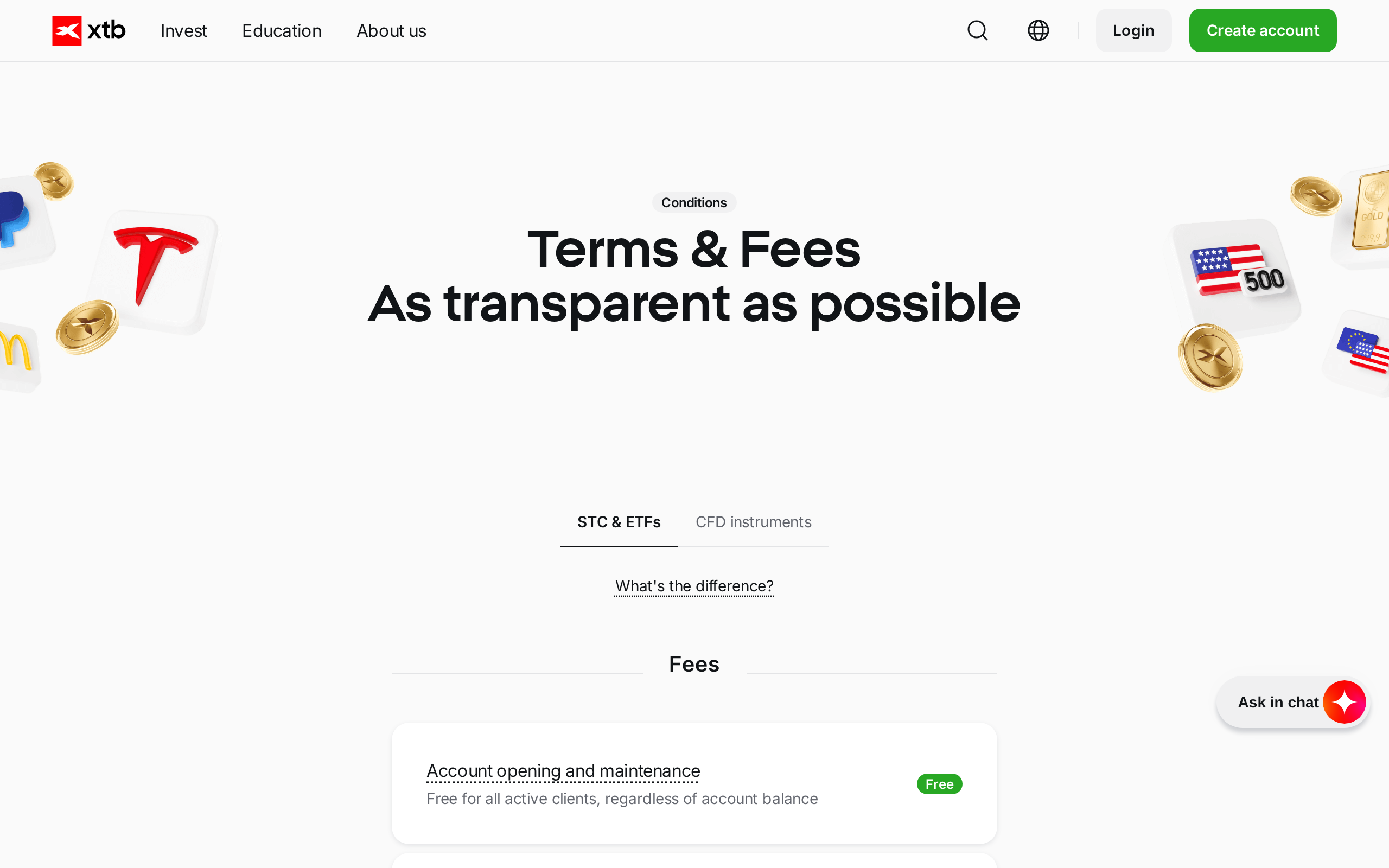
The fees page opens with the headline "As transparent as possible", and mostly earns it. Opening an account is free. Maintenance is free for active clients, whatever the balance. There is no minimum deposit. CFDs carry 0% commission, so your cost is the spread, and the published minimum is 0.5 pips. Independent averages put EUR/USD closer to 0.9 pips, which is fair for a zero-commission account but not raw-spread territory.
xtb.com
XTB's terms and fees page: account opening and maintenance are free for active clients.
Three charges matter more than the headline. A 0.5% currency conversion fee applies when your deposit currency differs from the instrument's, which adds up fast for a trader who funds in euros but buys US shares. Withdrawals above $50 are free, but below that a $30 flat fee applies, a trap only for people cashing out tiny amounts. And real stocks and ETFs are commission-free only up to EUR 100,000 of monthly turnover; above it you pay 0.2% with a EUR 10 minimum.
Why xStation 5 is the reason to sign up
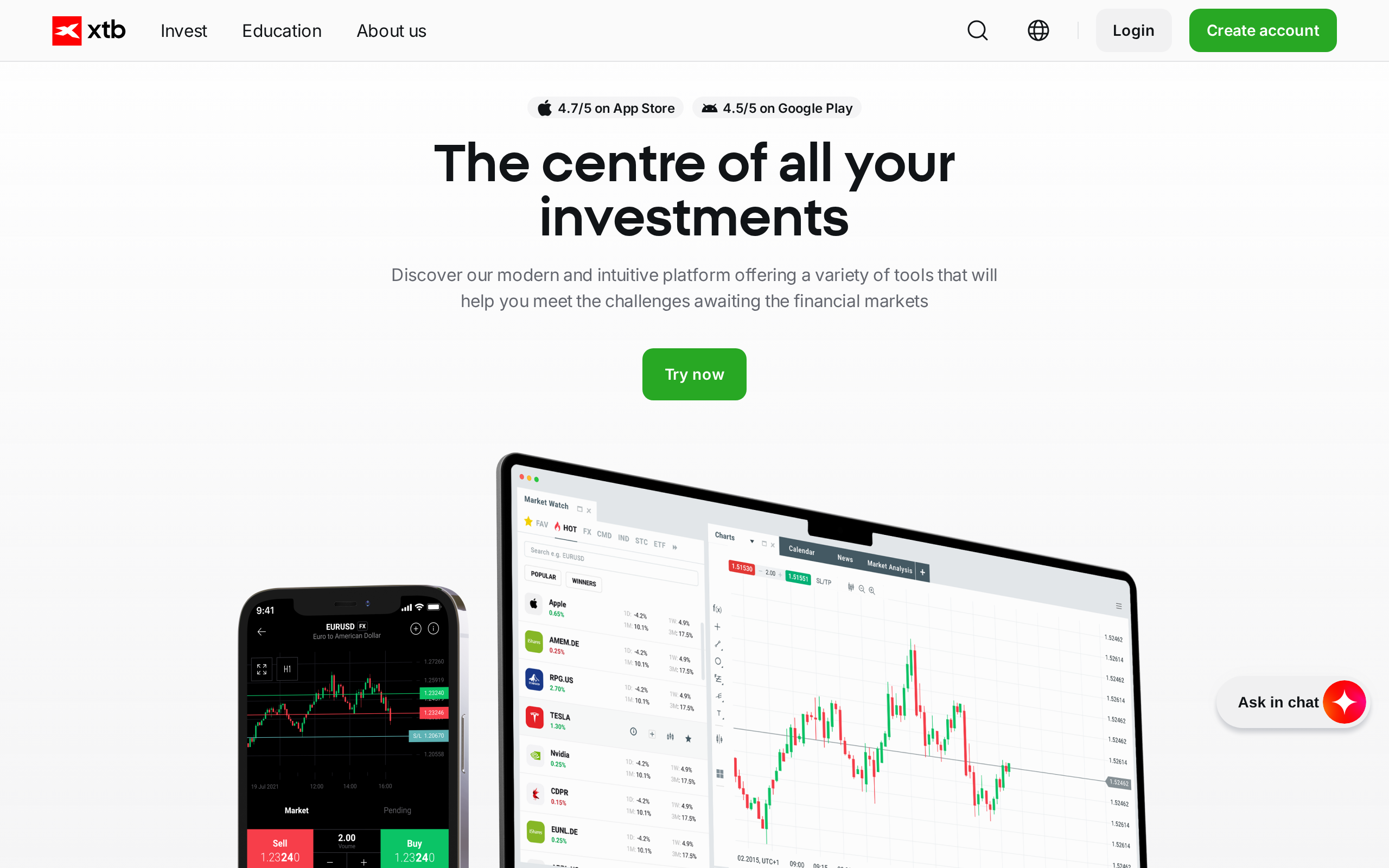
XTB does not lean on MetaTrader. Everything runs on xStation 5, on the web, on desktop and in iOS and Android apps that the company says hold ratings of 4.7 and 4.5. The platform page lists 12,000+ instruments and basic order types: stop loss, take profit and pending orders. It adds a client-positioning sentiment gauge, news alerts and an investment calculator.
xtb.com
XTB's platform page, which describes xStation as the centre of all investments.
That is an honest trade-off. A beginner gets one screen and a short learning curve. A scripter or an automation user gets very little, because there is no cTrader and the page lists no MetaTrader option. If you run expert advisors, this is the wrong shop.
Is the regulation strong enough for the money?
Here XTB is ahead of most CFD brokers. Independent reviewers list oversight from the FCA, CySEC, KNF, BaFin, CNMV, ACPR, CMVM, the IFSC and the CMB, and the parent company is listed on the Warsaw Stock Exchange, which forces regular audited reporting. That does not make a CFD account safe: the regulator protects the firm's conduct, not your trades. It does mean that a European client is covered by a local rulebook, including the 30:1 leverage cap on major pairs. The 1:500 maximum leverage on the fees page applies to non-EU entities, so check which entity you are placed with.
xtb.com
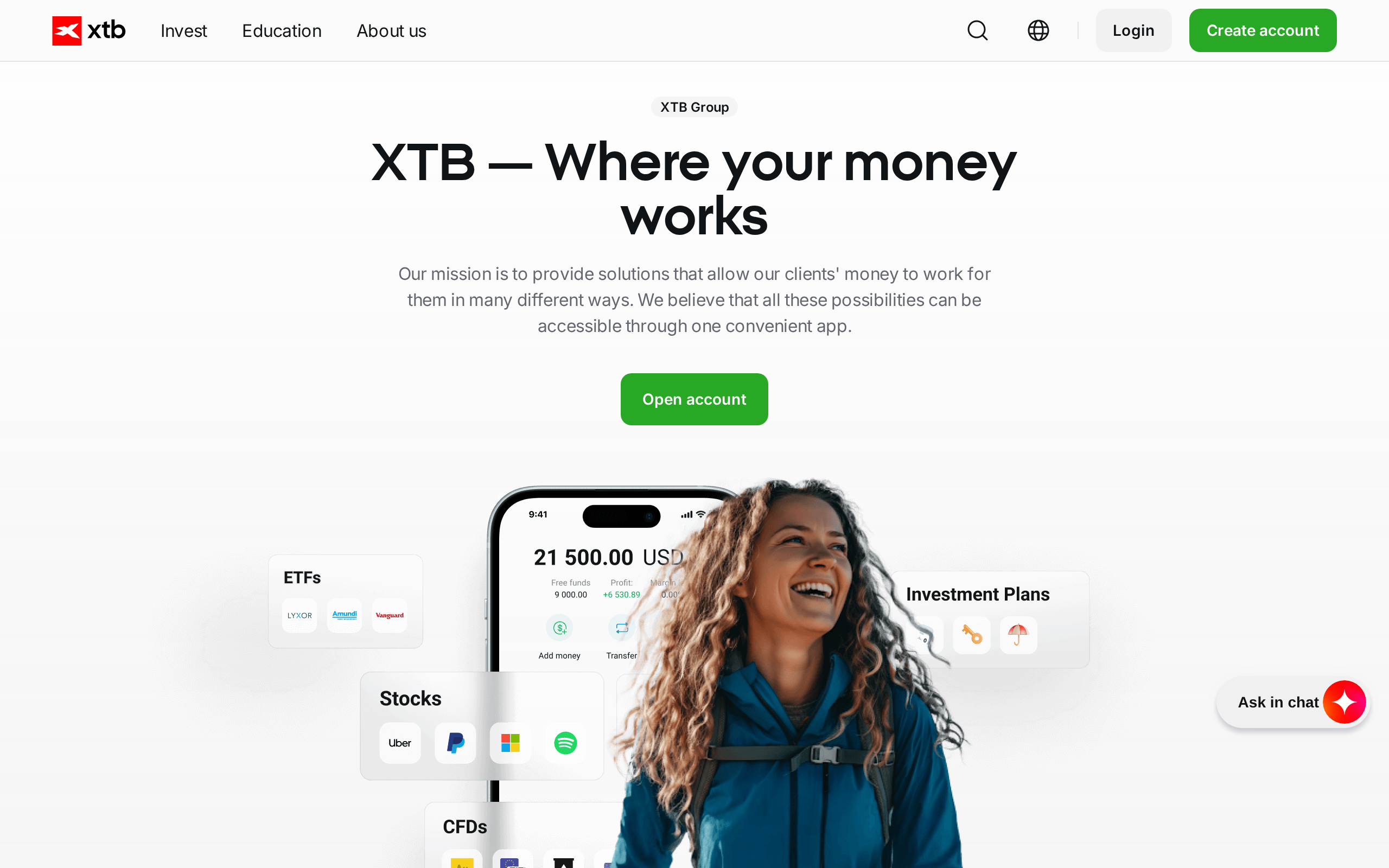
XTB's about page, stating the mission behind the single-platform approach.
How it stacks up against the usual alternatives
Against IG, XTB is cheaper to start and far easier to read, but it offers a fraction of the market depth and no spread betting. Against Pepperstone or IC Markets, it loses on raw cost and platform choice, and wins on having real shares and ETFs in the same login. Against eToro, it has no social layer at all, which some readers will count as a plus. The pattern is that XTB sits in the middle on price and near the top on clarity, a combination that suits people who would rather not audit five fee schedules.
Account funding deserves a line of its own. Deposits are free on XTB's side, though your card or bank may charge, and with no minimum you can test the platform with a small sum before committing real capital. That is a reasonable way to check execution on your own connection, which no review can do for you.
Who should pick XTB, and who should not
Choose it if you are in the EU or UK, you want to hold ETFs for the long run and trade a few currency pairs on the side, and you prefer one login for both. The cost structure is easy to audit, which is worth something.
Look elsewhere if you need tight raw spreads for scalping (a raw-spread account from Pepperstone or IC Markets will undercut a 0.9 pip average), if your charts live in TradingView, or if you fund in a currency that forces repeated conversions.
Verdict
XTB is the best all-round pick on this list for a European who wants simplicity without dubious regulation. It is not the cheapest broker, and it is not flexible. We rate it 8.4 because the things it does, it does cleanly.
Leveraged products can lose money quickly, and a majority of retail CFD accounts do. This review describes published terms and is general information, not personal advice.